Etiqueta: Asturias

  • Join us to celebrate the Natura 2000 day in Barayo (Asturias) on 26th of May

    Join us to celebrate the Natura 2000 day in Barayo (Asturias) on 26th of May

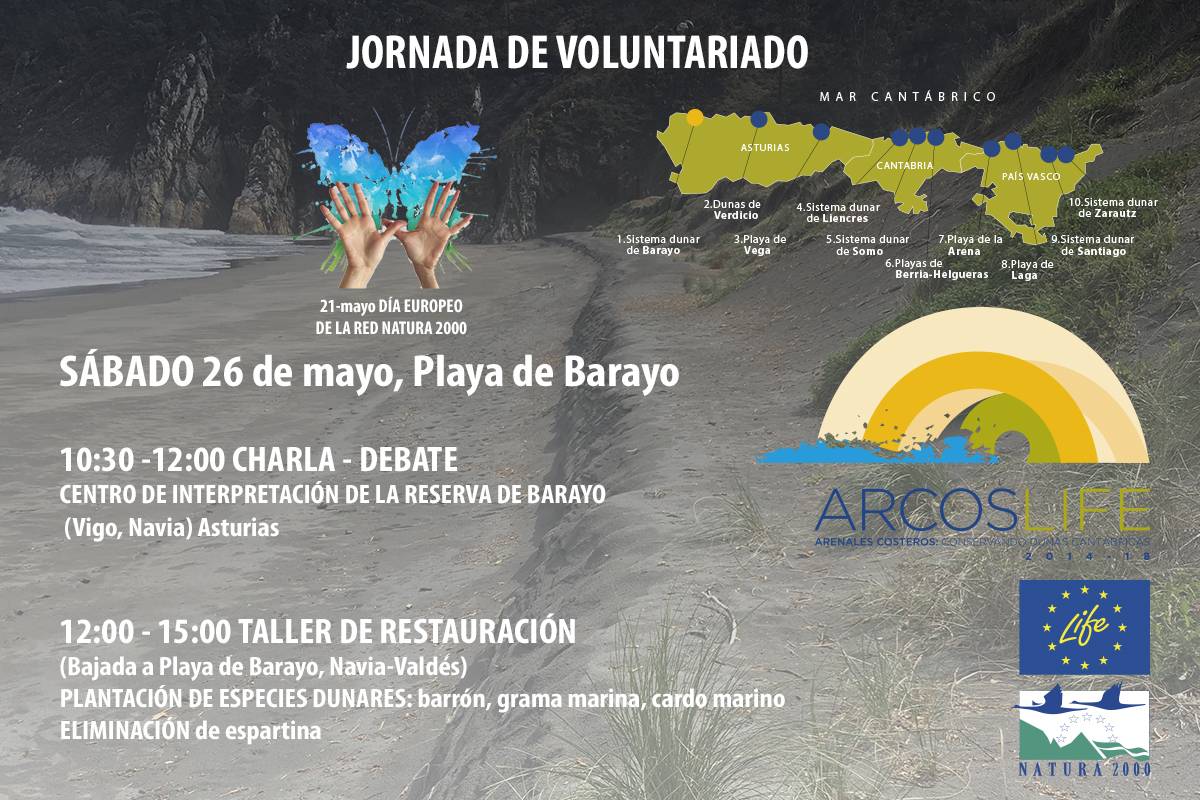
    Saturday, 26 May is almost here! We can’t wait to see you at the Barayo Natural Reserve (Navia, Valdés, in western Asturias) to learn about the dune that Life+ARCOS is working to restore and about the restoration techniques we use in these types of habitats.

    If you haven’t registered yet, click here. Registration is open until tomorrow, 24 May.

    Our presentation about the Barayo Reserve Interpretation Centre’s work is open to the public. We’ll talk a bit about the importance of the Natura 2000 Network, the conservation goals that inspired us to work in Barayo and items of public concern. We’ll also set aside some time to talk with those in attendance and to take family photos to commemorate our common goal of improving the natural conditions of this protected area.

    The timetable is as follows:

    Chat and debate (10:30 AM -12:00 PM)

    • Location: Barayo Reserve Interpretation Centre (Centro de Interpretación de la Reserva de Barayo) in Vigo (Navia).
    • Objective:ARCOS+Life team members from the University of Oviedo (INDUROT) and from the company Ecología Litoral S.L. will explain how we’ll be celebrating European Natura 2000 Network Day. They will also talk about Life+ARCOS projects, the history of Barayo in photos, and the main restoration tools we use.
    • Debate / chat: We’re interested in hearing what people think about this protected area, so please use this time to share your thoughts with us.

    Restoration and eradication of invasive species workshop (12:00 PM – 3:00 PM)

    • Location: Western side of Barayo beach.
    • Objective:The company that manages the dune plant nursery centre of the Directorate General for the Sustainability of the Coast and the Sea in Cantabria will explain the most common techniques used to restore dunes. Then, we’ll plant dune species and work to eradicate an exotic species that is invading part of the Barayo dunes. Don’t worry, we’ll teach you how to identify the invasive ones.
    • Group lunch: If the weather holds out (fingers crossed for no rain!), we’ll have lunch on the beach so we can get to know each other better. 

    To access the beach, the Friends of Barayo Association set up a bridge to the work area on the left side of the river. Thank you so much!

    The most important part: You can still register today and tomorrow by clicking here


  • Monitoring team visit LIFE+ARCOS actions in Asturias. 16-17 April, 2018

    Monitoring team visit LIFE+ARCOS actions in Asturias. 16-17 April, 2018

    Last week, a representative from the NEEMO team (which monitors LIFE projects) visited the Life+ARCOS project to observe its current state first hand.
    During the representative’s two-day visit, they reviewed the project’s financial and technical parts. The first meeting took place on 16 April at the Institute of Natural Resources and Land Planning headquarters (INDUROT-University of Oviedo), located at the Mieres Campus.

    Primera jornada, evaluación de la situación económica del proyecto.
    Day one: Evaluation of the project’s financial status

    On 17 April, the representative observed the work being carried out within the Barayo protected area (Navia and Valdés) and at Vega beach (Ribadesella), where dune system restoration work recently began.

    Other project members were also invited to the Barayo Partial Natural Reserve (SAC ES0000317 Penarronda-Barayo): Ecología Litoral, Provincial Council of Gipuzkoa, Aranzadi Science Society and Directorate-General of Environment of the Government of Cantabria.

    Elena Fernández explains erosion trends in the Barayo dune system.

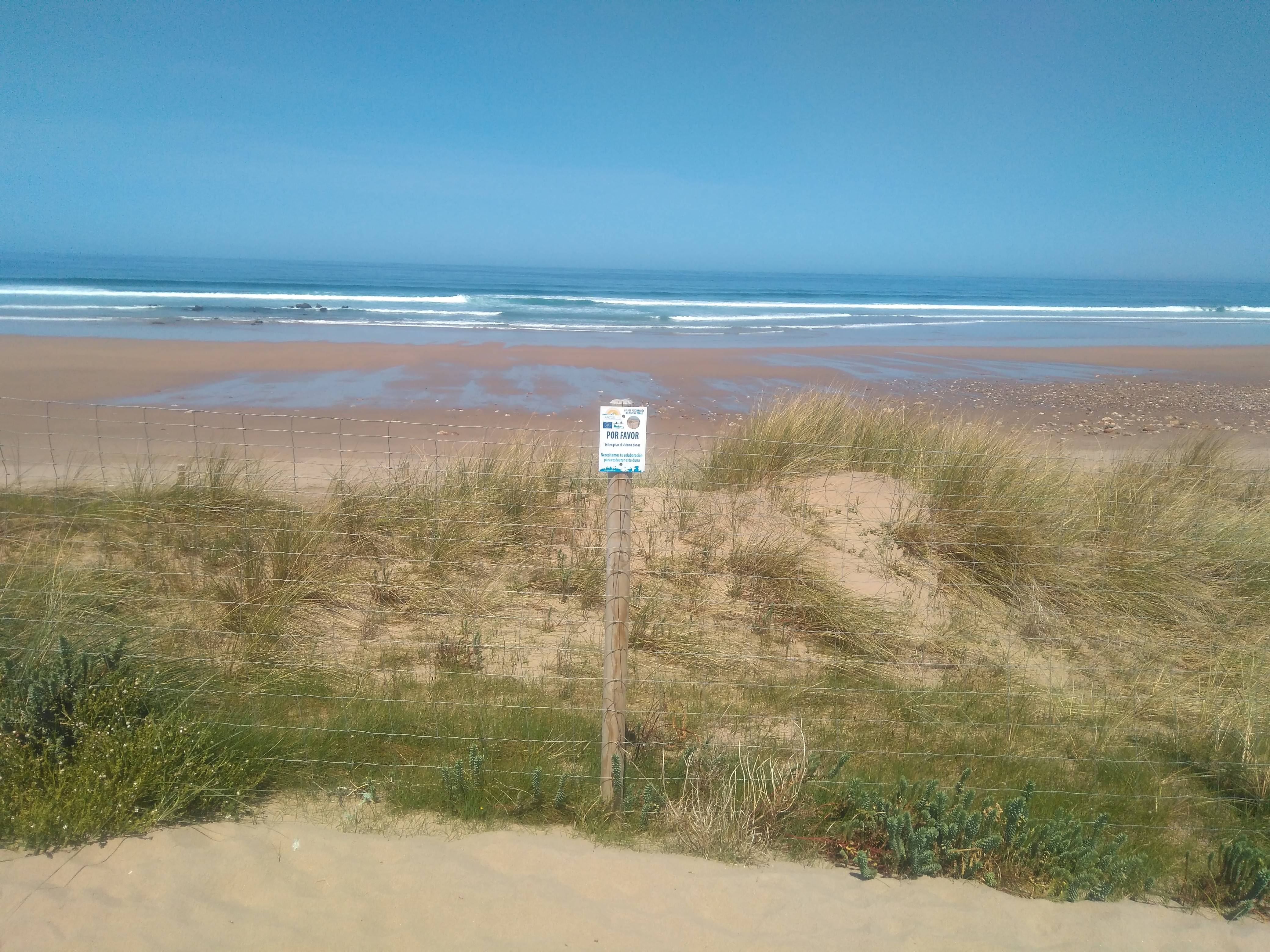
    At Barayo, we talked about the conservation problems this area faces and the steps we must take in order to begin restoring the dune ecosystem’s natural vegetation cover.

    That day, we also took new positioning measurements of the frontal dune with a sub-meter accuracy GPS receptor.

    Collecting frontal dune data via GPS

    After visiting Barayo, the team went to Vega beach in Ribadesella to see the results of the work done there. In this area, the closures and decrease in foot traffic inside the dune system has allowed vegetation to recover. In the area you could also see the effect storms had on some of the work carried out. Significant damage was done to the sand collectors and to some of the frontal closures.

    Presentation on Vega beach erosion trends, given by Elena Fernández (INDUROT)
    Dune vegetation recovery on Vega beach after closing transversal access points to the beach
    Evaluation of damage on Vega beach

    After visiting Vega beach, the team went to Ribadesella to have lunch at the «Tito Bustillo» Cave Interpretation Centre. Afterwards, we reviewed the work carried out by other teams at different work sites. The meeting was held at facilities generously provided by the Council of Ribadesella.

    Technical meeting at the offices of the Council of Ribadesella.
  • The Asturias dunes in the 50’s and today. Do you want to see it?

    The Asturias dunes in the 50’s and today. Do you want to see it?

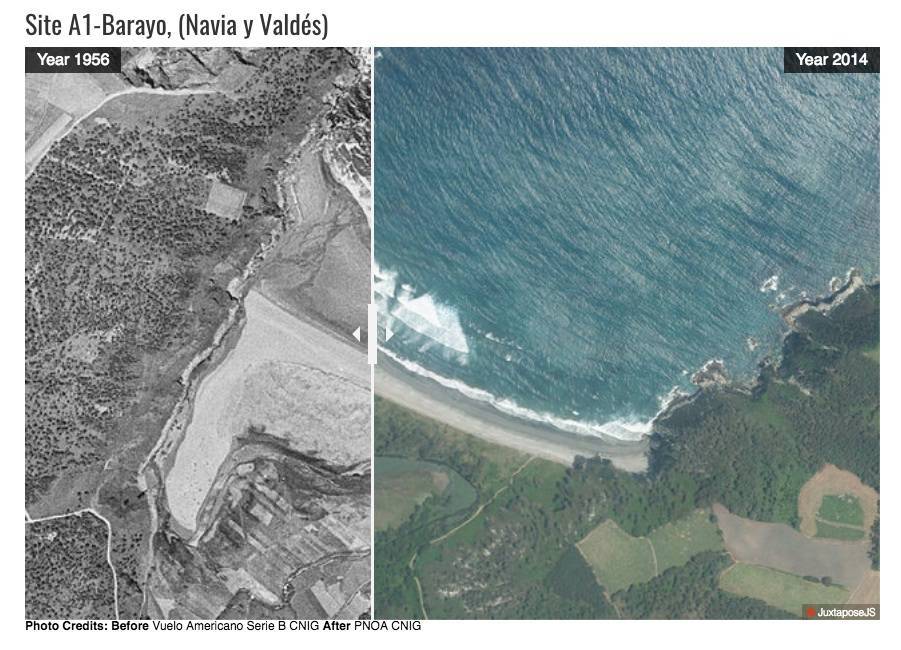
    This aerial photograph was taken in the 1950’s by the American army. It shows what the dune system landscape looked like in those years. We have compared it with current images from the Spanish National Plan for Aerial Orthophoto.

    In the following photos you can see images of all the Asturian areas where the Life+ARCOS project carries out its work: from the 50’s and from 2014.  You can clearly see how much the area has changed. Click and drag over the photos so you can see how the area looked before and now. It is as easy as that.

    It is true that it will be impossible for us to recover the area the dune systems covered in the past, but here at Life+ARCOS, we believe the sandbanks still deserve a chance. We are working on it.

    We hope you enjoy it.

    Site A1-Barayo, (Navia and Valdés)

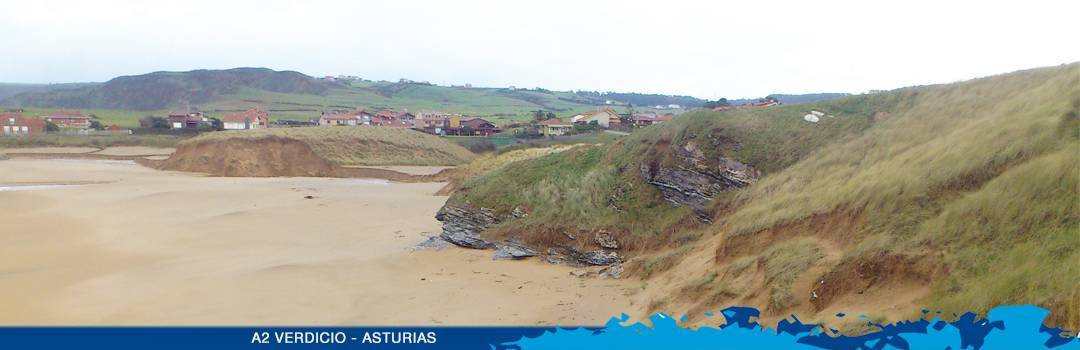
    Site A2-Verdicio (Gozón)

    Site A3- Vega Beach (Ribadeslla)

  • Sign up now! On 21st May 2016, we are celebrating the European Natura 2000 day by removing invasive exotic species from the dunes in Verdicio, Asturias

    Sign up now! On 21st May 2016, we are celebrating the European Natura 2000 day by removing invasive exotic species from the dunes in Verdicio, Asturias

    Last minute note

    [box type=»warning»] WE HAVE CLOSED THE REGISTRATION FORM[/box] [box type=»info»]

    THANK YOU ALL FOR PARTICIPATING. WE WILL CONTINUE TO ORGANISE MORE EVENTS TO CONSERVE THE CANTABRIAN DUNES. STAY TUNED[/box]

    A2-VERDICIO

    On Saturday 21st May 2016 the Life+ARCOS team invites you to join us to carry out volunteering action to remove some invasive exotic species on the Verdicio Beach (Luanco, Asturias), a protected space that is included within the Cabo Busto-Luanco Special Area of Conservation (SAC ES1200055), and therefore is part of the Network of Protected Spaces included in the Natura 2000 Network.

    If you do not live in Asturias, Life+ARCOS is also holding other activities on the same day in Cantabria and in the Basque Country. Stay tuned to our website where we will post more information shortly.

    What will we be doing?

    The idea is to be able to spend a Saturday in a natural protected space, and to help improve its state of conservation, with the assistance of citizen participation. Various members of the Life+ARCOS team will be present in Verdicio, T. E. Díaz, Álvaro Bueno, Nacho Felpete, Elena Fernández and other people. We will talk about the space and will give you instructions on how to remove some particularly problematic invasive species that are tricky to remove manually.

    How long will it last?

    The plan is for everyone interested in participating to already be in Verdicio by 11:00 am. Our intention is to close the day by around 3 pm, so that participants can either stay to eat or return home with no problem.

    Schedule: 11:00 to 15:00

    How can I take part?

    Fill out this registration form so you will be covered by the insurance that we take out with the University of Oviedo. It is essential for us to have the names of participants and their national identity document. In Verdicio we will ask you to sign a participation sheet to make sure our list coincides.

    Use the form fields to give any additional information such as if you can share a car to reach the location, for example, or if you will be accompanied by children, and above all: an e-mail address or telephone number so we can contact you.

    Contact us with any queries on the following contact page. We will be delighted to help.

    Over the coming days we will publish more information with more details.

    TAKE PART!

    The Life+ARCOS team