Etiqueta: Monitoring

  • Life+ARCOS launches a public survey  to evaluate public awareness about dune conservation

    Life+ARCOS launches a public survey to evaluate public awareness about dune conservation

    We value your opinion. Can you tell us about a beach on the Cantabrian coast? 
    It will only take5 minutes!

    Thank you very much for your help!

    Kantauriko hondartza bati buruz duzun iritzia jakin nahiko genuke, lagunduko diguzu?
    Soilik 5 minutu pasako dituzu!

    Eskerrik asko parte-hartzeagatik!

    Click here to access the survey or do it here.

    Survey in Basque

    Survey in Spanish

  • Monitoring team visit LIFE+ARCOS actions in Asturias. 16-17 April, 2018

    Monitoring team visit LIFE+ARCOS actions in Asturias. 16-17 April, 2018

    Last week, a representative from the NEEMO team (which monitors LIFE projects) visited the Life+ARCOS project to observe its current state first hand.
    During the representative’s two-day visit, they reviewed the project’s financial and technical parts. The first meeting took place on 16 April at the Institute of Natural Resources and Land Planning headquarters (INDUROT-University of Oviedo), located at the Mieres Campus.

    Primera jornada, evaluación de la situación económica del proyecto.
    Day one: Evaluation of the project’s financial status

    On 17 April, the representative observed the work being carried out within the Barayo protected area (Navia and Valdés) and at Vega beach (Ribadesella), where dune system restoration work recently began.

    Other project members were also invited to the Barayo Partial Natural Reserve (SAC ES0000317 Penarronda-Barayo): Ecología Litoral, Provincial Council of Gipuzkoa, Aranzadi Science Society and Directorate-General of Environment of the Government of Cantabria.

    Elena Fernández explains erosion trends in the Barayo dune system.

    At Barayo, we talked about the conservation problems this area faces and the steps we must take in order to begin restoring the dune ecosystem’s natural vegetation cover.

    That day, we also took new positioning measurements of the frontal dune with a sub-meter accuracy GPS receptor.

    Collecting frontal dune data via GPS

    After visiting Barayo, the team went to Vega beach in Ribadesella to see the results of the work done there. In this area, the closures and decrease in foot traffic inside the dune system has allowed vegetation to recover. In the area you could also see the effect storms had on some of the work carried out. Significant damage was done to the sand collectors and to some of the frontal closures.

    Presentation on Vega beach erosion trends, given by Elena Fernández (INDUROT)
    Dune vegetation recovery on Vega beach after closing transversal access points to the beach
    Evaluation of damage on Vega beach

    After visiting Vega beach, the team went to Ribadesella to have lunch at the «Tito Bustillo» Cave Interpretation Centre. Afterwards, we reviewed the work carried out by other teams at different work sites. The meeting was held at facilities generously provided by the Council of Ribadesella.

    Technical meeting at the offices of the Council of Ribadesella.
  • Life+ARCOS starts to analyse sand inputs on the Asturian dunes

    Life+ARCOS starts to analyse sand inputs on the Asturian dunes

    For the state of conservation of the Cantabrian dunes to be assessed correctly, first we must find out if its current dynamic contributes to the formation of embryonic dunes.

    With this target in mind, the Institute of Natural Resources and Territorial Planning team (INDUROT) from the University of Oviedo, led by Jorque Marquínez (director of INDUROT) and Rosana Menéndez (lecturer assigned to the project), has begun to undertake studies on the Verdicio beach in Gozón (Asturias), which will be followed by similar procedures on the dunes on the Barayo and Vega beaches.

    Follow-up of the sand variation on the dune

    After the winter storms, follow-up works have begun to return the sand to some of the beach-dune systems that are the focus of action within the Life+ARCOS project. The wind, the type and amount of sand, as well as a lack of heavy storms, are key factors that have repercussions on the speed of dune recovery.

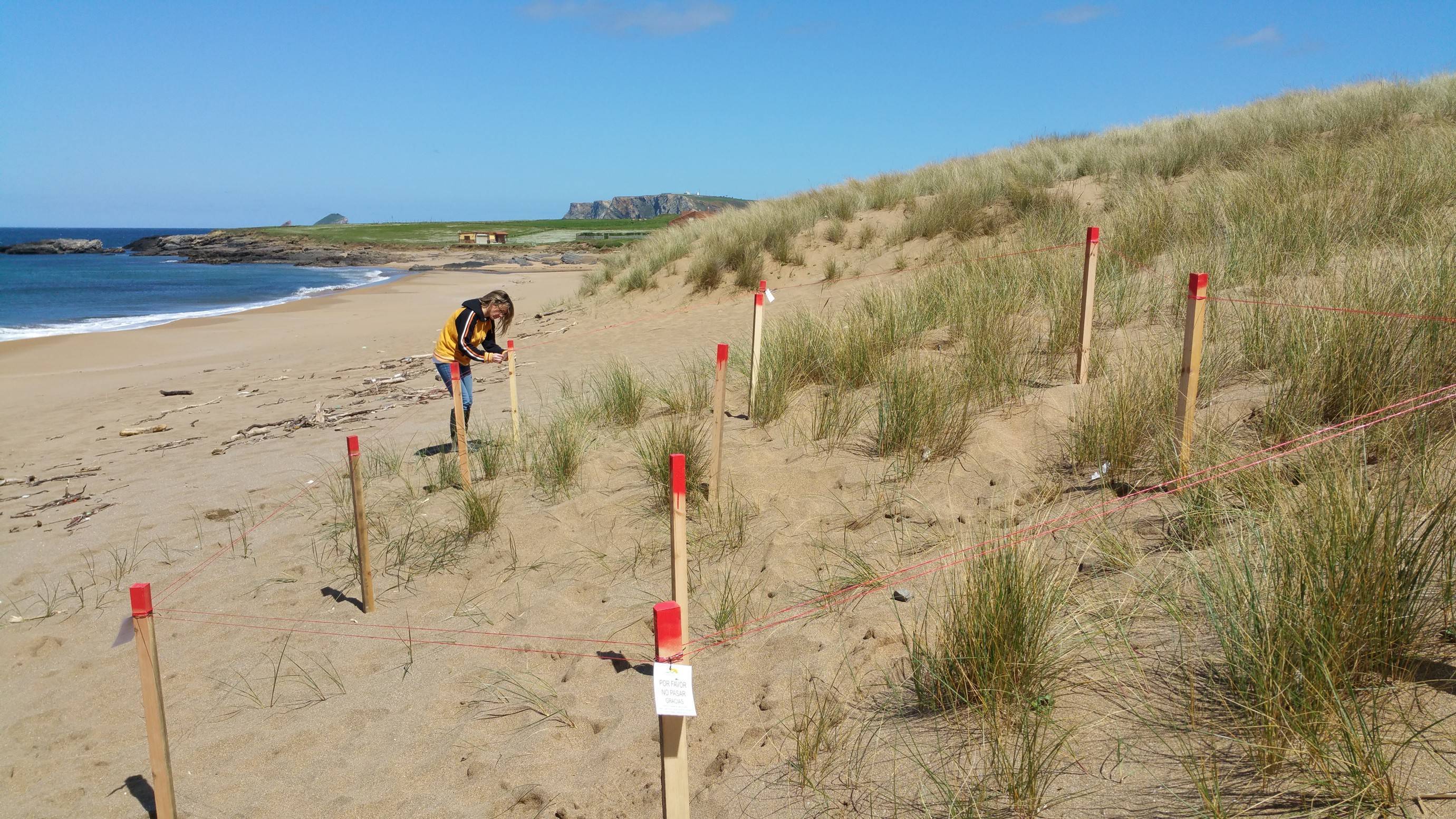
    In this respect, follow-up has been initiated on some of these variables, including the amount of sand input using monitoring by staking the study site. The results of this measurement will provide information so that balances or imbalances in the system can be identified and measures can be taken accordingly. For this reason, it is crucial to avoid any human interference in the study area that could alter the results of the analysis.

    If you visit any of these three beaches and you come across the staked follow-up area, please avoid walking inside the enclosure so that the measurements we get are as precise as possible.

    Clavando_estacas

    Elena Fernández fitting the sand-input follow-up system on the Verdicio beach dune system

    Vista_aerea_loc
    Definitive location of the sand-input measurement elements
    Preparacion_listones
    Snapshot of the elaboration process of the measurement stakes
    numeracion_cartelas
    Numerical allocation of each of the stakes for follow-up
    Detalle_etiquetas
    Signs warning beach visitors of the scientific use of the measurement stakes to avoid them being removed